
A World Cup Shared with Millions of Fans
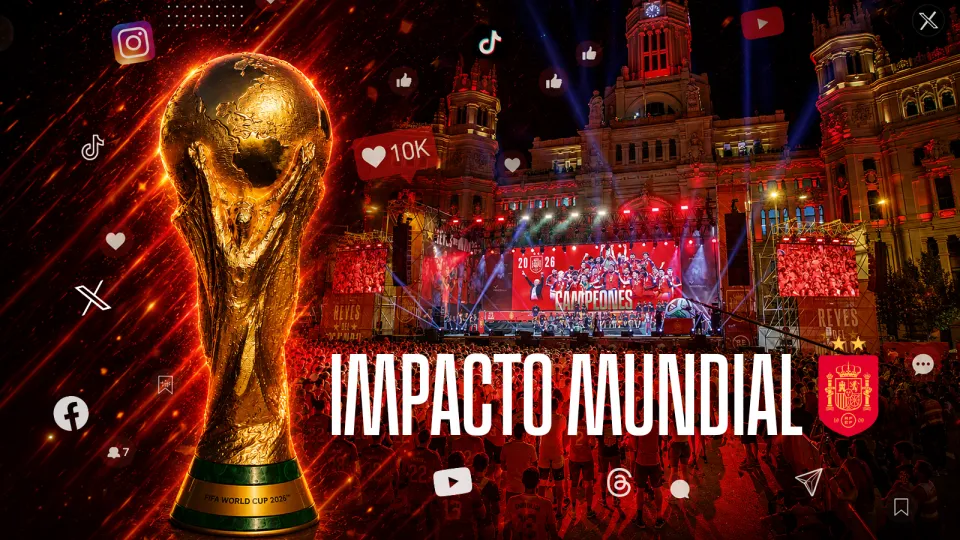
The journey to Spain's second World Cup star has become one of the defining moments in the recent history of the national team, significantly enhancing its global profile in the months leading up to and throughout the tournament. Momentum had been building ever since His Majesty the King announced Luis de la Fuente's World Cup squad, and it culminated in an extraordinary level of worldwide engagement.
Behind that success was a comprehensive communications strategy developed by the Royal Spanish Football Federation (RFEF), bringing supporters closer to the national team than ever before and strengthening the bond between the squad and millions of fans throughout the competition.
Record Growth Across Social Media
The official Spain national team accounts, @SEFutbol, gained 6.7 million new followers during the World Cup, increasing their audience by 31 per cent in just two months.
Throughout the tournament, the RFEF operated as a fully integrated 24/7 digital media organisation, producing a constant stream of content designed to keep supporters connected every day. The strategy focused on revealing the team's human side through exclusive behind-the-scenes footage, feature stories, match previews, training access, documentaries, AI-powered projects and personal stories involving players and coaching staff.
New short-form formats were created specifically for Instagram and TikTok, delivering more emotional, authentic and platform-specific storytelling.
Several videos became global trends, including a tribute to the city of Chattanooga and a film showing New York turning red with Spain shirts ahead of the World Cup final.
Among the flagship productions was the podcast The Star That Unites Us, featuring conversations between Spain's 2010 world champions and members of the current squad, alongside a special episode with Lamine Yamal, Nico Williams and Dani Martínez, which surpassed one million views on YouTube.
The documentary series World Cup Vlog followed Spain's journey through nine episodes, each built around one defining value—hope, pride, confidence, composure, motivation, ambition, resilience, leadership and family—using unseen footage and first-hand reflections from players and staff.
Post-match interviews, including Mikel Merino's emotional reaction after his dramatic goals against Portugal and Belgium, together with celebrations on the pitch and aboard the team bus following the final, each exceeded 25 million Instagram views.
Across Instagram alone, Spain's World Cup content generated 2.7 billion views and more than 93 million interactions, including likes, shares and reposts.
The national team's refreshed visual identity also proved hugely successful, producing some of the tournament's most widely viewed content:
- "World Champions" – 316 million views
- "Into the Final" – 137 million views
- The trophy-lift photograph – 81 million views
Outstanding Media Impact
Between 25 May and 21 July, activity relating to the RFEF and the Spain national team generated 11.5 million media articles worldwide.
According to analysis by Onclusive, that coverage produced an Advertising Value Equivalent (AVE) of €643 million, estimating what equivalent advertising exposure would have cost, while generating 41.4 billion Opportunities to See (OTS)—the estimated number of potential audience impressions.
The Numbers Behind Spain's Digital Success
During the World Cup, @SEFutbol grew from 21.5 million to 28.2 million followers, adding 6,683,242 new followers and increasing its audience by 31 per cent.
TikTok recorded the strongest growth, adding 3.5 million followers (+65%), while Instagram gained more than 2 million (+27%).
By the end of the tournament, the Spain national team's combined social media audience across Instagram, TikTok, Facebook, X, Threads and YouTube had reached 28.3 million followers.
On TikTok alone, Spain's content attracted:
- 51 million unique viewers
- 357 million video views (+470%)
- 36 million likes
- Almost 250,000 comments
- 764,000 shares
Across all official RFEF accounts, the Federation concluded the tournament with a combined audience of 34.3 million followers, having added 6.8 million new users, representing overall growth of 24.7 per cent.
Alongside @SEFutbol, significant audience growth was also recorded across SEFutbolFem, RFEF, Primera Federación, FUTFEMRFEF, La Academia, Entrenadores RFEF and Fútbol Playa, strengthening the Federation's digital presence across every area of Spanish football.
The official RFEF and national team website also played a central role throughout the competition, publishing 235 news articles while streaming training sessions and press conferences live.
Serving the World's Media
The tournament also demanded an extensive international media operation.
Throughout the World Cup, the RFEF coordinated:
- 215 one-to-one interviews with players and coaching staff.
- 245 post-match flash interviews for official television and radio rights holders.
- 34 press conferences, including 20 official FIFA media conferences and 14 organised by the RFEF.
Media activities also included mixed-zone appearances before every match involving all 26 players, while more than 35 players and staff spoke to journalists after games.
Overall, the communications team provided services for more than 120 accredited Spanish journalists, with the number of media representatives rising to over 215 as international interest intensified during the knockout stages and World Cup final.
The result was a communications campaign that matched the team's achievements on the pitch—bringing Spain's World Cup story to millions of supporters around the globe while reinforcing the national team's position as one of the world's leading football brands.