
Clásico Cup Final History
FC Barcelona and Real Madrid have played seven previous historic duels for the Copa del Rey trophy, the first of them on 21 June 1936.
The 2025 Spanish Cup final will be the eighth in the history of the Copa del Rey between FC Barcelona and Real Madrid CF.
Of the seven previous finals, Real Madrid have won four (1936, 1974, 2011 and 2014) and Barça have won three (1968, 1983 and 1990).
1936
The last final before the Civil War
1936 was a terrible year for Spain and a prelude to a catastrophe for the world. Just one month before the outbreak of the Civil War, the Cup final was played, the last one before the conflict and the last one played by Ricardo Zamora.
On 21 June 1936, FC Barcelona and Madrid F.C. met at the Mestalla stadium in Valencia in the final of the final Cup of the President of the Republic.
On a hot Sunday, in an pre-war political atmosphere, Madrid and Barcelona played the first final between the Culés and the Merengues. It was the third final on the banks of The River Turia after 1926 and 1929. The Mestalla, which had a capacity of 19,000 spectators, was packed to the rafters, so much so that it was overflowing with fans (there were around 22,000 people in the stands, according to the newspapers of the time). In fact, people paid as much as 50 pesetas for tickets that were worth 6 pesetas at face value.
The madridistas seemed to have settled the game after a quarter of an hour with goals from Eugenio and Lecue. The Whites, thanks to a memorable defence made up of internationals Ciriaco and Quincoces, held off a blaugrana side.
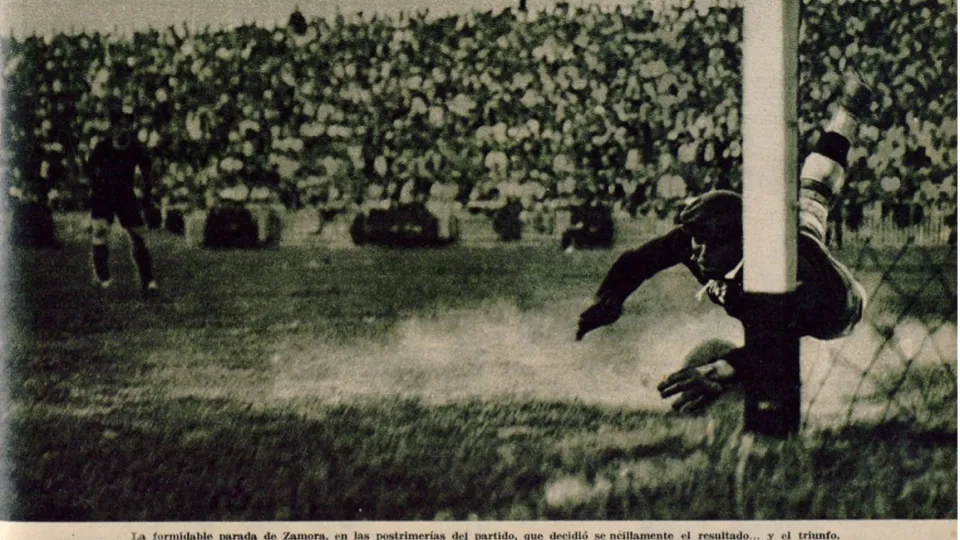
The Catalans not only managed to close the gap thanks to Escolá's goal, but also came close to forcing an equaliser, but Zamora made one final great save for fans to savour.
The newspaper La Vanguardia recounted the save by the Madrid goalkeeper that became an iconic image in the history of our football, Escolá's shot and the save by ‘El Divino’ (the devine one):
‘At thirty-eight minutes a magical bit of play takes place. Its result, favourable to the team from Madrid, was the one that decided the match. It was initiated by Ventolrá, who put in a precise ball across quite close to the keeper. The ball was some five metres from Zamora and Escolá and Raich had a magnificent chance to finish. They were alone in front of the Madrid goalkeeper and Raich missed the first attempt. But Escola, clever as ever, decided to shoot and he did it calmly and very well placed. Because of the close range of the shot and the cover, Zamora could not anticipate the trajectory of the shot. By intuition, he threw himself to the side where the ball was sent and stopped it ‘at full stretch’. As such, after this play, followed a moment of maximum emotion by all those present, Madrid banished the spectre of a draw’.
Indeed, Barcelona captain Ventolrá was very honest at the end of the match, acknowledging the superiority of the opposition: ‘I have to apologise to the fans. I have felt ashamed at times to be the captain of this team. Suffice to say that with a bit of commitment we would have been Cup champions of Spain’.
Ricardo Zamora received the trophy from Mariano Ruiz-Funes, Minister of Agriculture in the government of the Second Republic. The latter, who came to Mestalla in place of the president Manuel Azaña, was very sincere when asked what he thought of the match: ‘I don't want to give my opinion because I don't know football, and I only talk about what I understand’.
A few days later, the news that seemed to be the news of the summer broke. Before that fateful 18 July, what most focused the attention of football fans that month was the news that Ricardo Zamora had hung up his boots. The first-choice goalkeeper for the Spanish national team since 1920, who was also the goalkeeper for Madrid FC, at that time reigning Cup champions, was leaving the game for good. The most charismatic player in Spanish football in the 1920s and 30s, both on and off the pitch, was calling it a day. The weekly newspaper As broke the news at the end of June, on the 29th, with a shocking headline: ‘Ricardo Zamora leaves football!’; and for the next month there was no other news in Spain. Something that the Civil War was to nip in the bud.
To reach the final, Madrid knocked out surprise package Hercules, who in turn had eliminated reigning champions Sevilla. The azulgrana had to overcome Sporting, Espanyol and Osasuna.
Match report 1-0 M. 5 Eugenio; 2-0 M. 11 Lecue: 2-1 M. 29 Escolá |
1968
The final of the bottles
We had to wait 32 years to see another final between the Merengues and the Culés. On Thursday 11 July 1968, Real Madrid and Barcelona met again in a cup final that went down in history for its controversy - it is known as the ‘final of the bottles’. It was undoubtedly an emblematic year, 1968: the world was focused on France and the consequences of ‘May “68” while De Gaulle was trying to survive politically.
In Spain, attention was focused on the great derby that ended the football season. The Cup final was played later than ever (almost in mid-July) and ended in a victory for the Azulgrana with an own goal by Fernando Zunzunegui; but the image that has remained is that of the throwing of objects and bottles by the Madrid fans who were very unhappy with the decisions of the referee Antonio Rigo.
Madrid (after eliminating Sevilla, Zaragoza and Celta) arrived at the final as league champions, but with seven absentees, two of them notable in terms of importance: Coach Miguel Muñoz could not count on either Gento or Velázquez -nor their natural substitutes- nor did he have Veloso at his disposal.
The Catalans knocked out Atlético de Madrid (who in turn knocked out defending champions Valencia) in the semi-finals. Real Gijón, Real Sociedad and Atlético de Bilbao were their victims in previous knockout rounds.
In the days leading up to the match, the Merengues stayed close to Madrid, in Navacerrada, and the Culés in El Escorial, where Artigas, the coach of the Catalan team, caused a surprise by deciding to field a young Rexach on the left wing instead of Oliveros. There was time for everything, including good food.
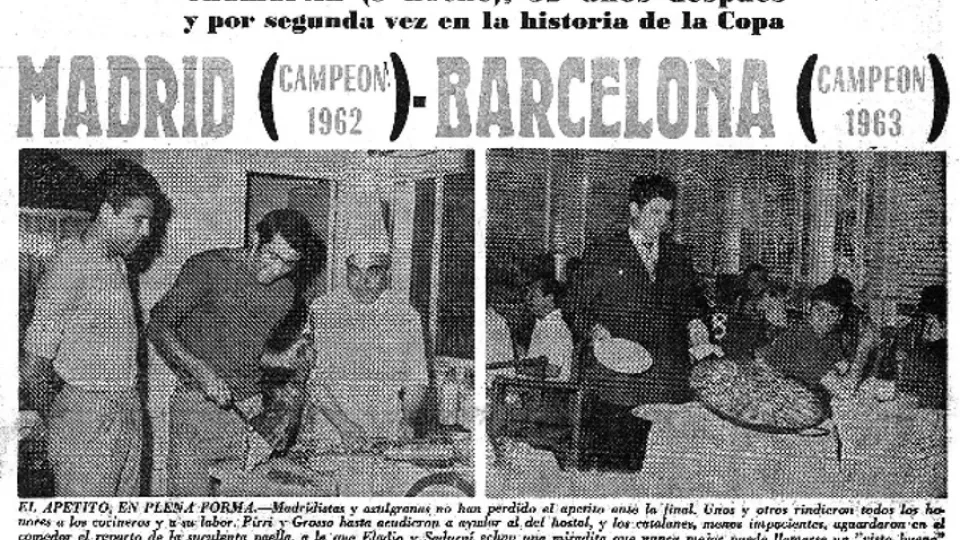
On 11 July, the 1962 champions met the 1963 champions, the great clásico of Spanish football whose last precedent had taken place 32 years earlier, in 1936.
The match fell far short of expectations, and Real Madrid, who started as favourites, were unable to overcome a Barcelona side in dire need of silverware.
The match was marked by an unfortunate moment for the Whites, which ended with an own goal by Zunzunegui when he deflected Rexach's cross into his own net just six minutes into the game. His teammate Betancort, the Blancos' goalkeeper that night, ironically described the Galician defender's inadvertent shot as “the best he has ever made in his life”.
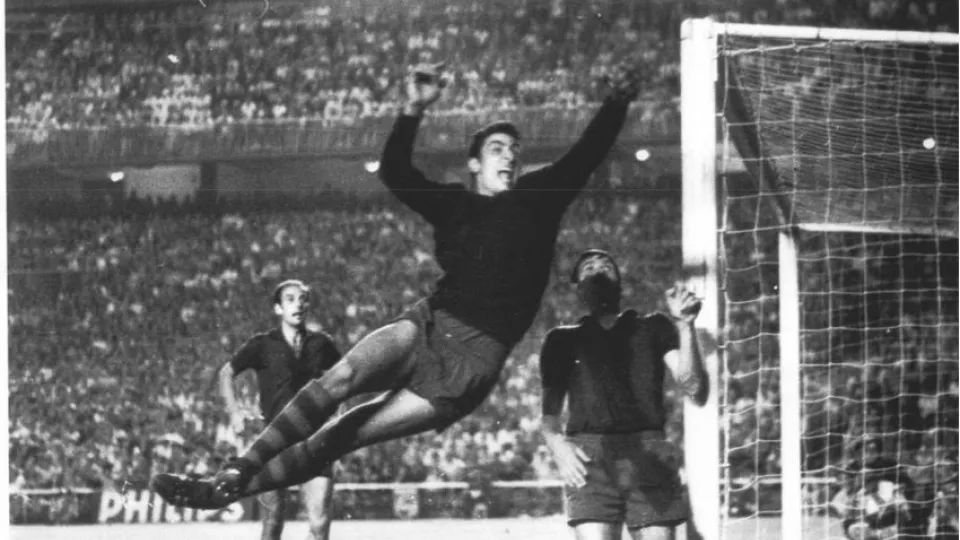
Barcelona fell back to defend their area to protect a splendid Sadurní and the match became so tough that even two of the Whites' players took the brunt of the lockdown: José Luis and, above all, Pirri who, after a tackle by Gallego, returned to the pitch with a dislocated collarbone.
The match was a duel between the Whites' attack led by a skilful Amancio and a cohesive Culé defence with Sadurní stopping everything.
Sixteen minutes into the second half the big controversy began. Serena entered the area and fell in front of Eladio. Rigo did not blow the whistle, which started the raining down of bottles that continued throughout the game as the referee made other decisions that were not to Madrid's liking.
In the daily newspaper Sport, the Culé goalkeeper Sadurní later recalled that ‘so many bottles were thrown at me from the stands that, from then on, the sale of glass bottles in glass was banned in football grounds’. Even the Madrid players asked, unsuccessfully, their supporters to stop throwing such bottles.
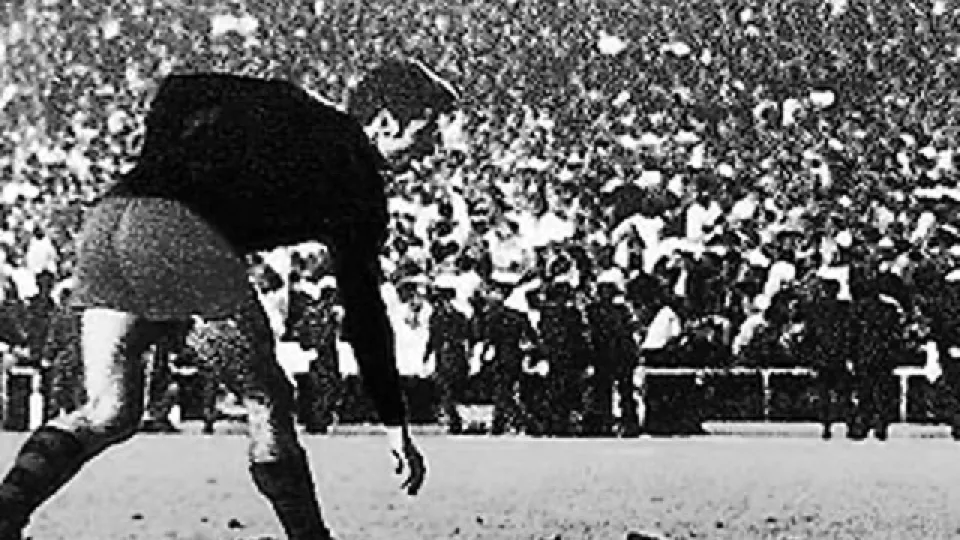
The match also produced other anecdotes, such as the one told by the then president of Barcelona, Narcís de Carreras, who incidentally left the pitch hoisted by the players: ‘When Franco had left the box, the wife of Camilo Alonso Vega, then Minister of the Interior, turned to Bernabéu and said: ’Don Santiago, we've lost. What a disgrace. And her husband, seeing that I had heard him, said to her: ‘Congratulate the president of Barcelona’. She said to me in confusion: ‘Oh, of course, of course.... I congratulate him because... Barcelona is Spain, isn't it? I said to her, quietly, ‘Senyora... no way!
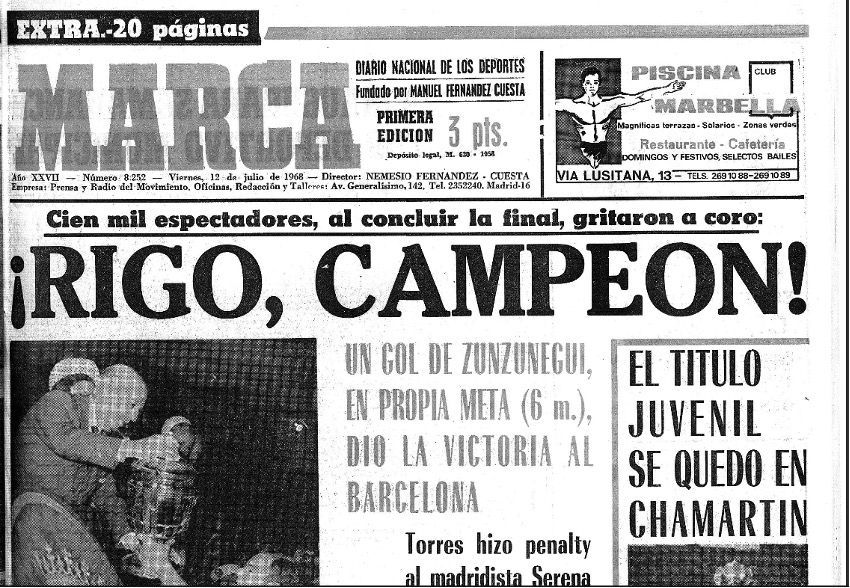
Rigo was criticised for not calling possible penalties, especially one on Fernando Serena. In his defence, Rigo commented: ‘I didn't see a penalty on Amancio and Serena jumped. Serena tripped and tried to trick me by letting himself fall when he was millimetres inside the area’.
Marca's headline was devastating against Rigo.
The azulgrana team were clear who to dedicate that victory to: their team-mate Julio César Benítez, the great Uruguayan full-back, who died surprisingly on 6 April after eating bad mussels.
Match report Real Madrid CF: Betancort; Miera, Zunzunegui, Sanchís; Pirri, Zoco; Serena, Amancio, Grosso, José Luis and Miguel Pérez. CF Barcelona: Sadurní; Torres, Gallego, Eladio; Fusté, Zabalza; Rifé, Pereda, Mendoza, Zaldúa and Rexach Referee: Rigo (Col. Balear) 1-0 M. 6 Zunzunegui (p.p.) Santiago Bernabéu (100 thousand spectators), 11 July (21:00) |
1974
Madrid crowned champions after thrashing (4-0) Barcelona
While the entire world turned its eyes to Germany where the World Cup was being held that year, Spain, with its national team not qualified for that tournament, enjoyed the final of the Spanish Cup.
The 1974 edition was the third cup final between Real Madrid and Barcelona, after those of 1936 and 1968, and the clash ended with an unexpected result: 4-0 in favour of the Whites. A final influenced by a previous match in which the Blaugrana, brilliant league champions, won 0-5 at the Bernabéu.
In the 1973/74 season Barcelona won the League after fourteen years of drought. The arrival of Johan Cruyff after the campaign had started revitalised a dejected team that went on to thrash Real Madrid 0-5 at the Santiago Bernabéu stadium. Almost five months after that result, both teams met again in the Copa final.
“There wasn’t anything exceptional or any special team talk from Molowny at the team hotel or anything. But we all had the feeling that we wanted to and had to beat Barcelona. We weren’t thinking of winning 4-0 or avenging the 0-5, but just of beating them. We were all together though,” confessed Santillana in an interview.
But in that great final neither Cruyff on the Barcelona side nor Netzer on the Madrid side were present. Madrid had got the better of Betis, Granada and in the semi-finals UD Las Palmas along the way. The Blaugrana, who dreamt of a league and cup double, had faced Real Oviedo, Español and Atlético de Madrid.
The match, which was played on Saturday 29 June at the Vicente Calderón, had little in terms of the teams establishing an early pace, as by the fifth minute the team from the capital were already leading thanks to a goal from Santillana who finished off a counterattack led by Aguilar.
After the goal, Madrid seemed to lose intensity and Barcelona could have equalised, but Clares, Rexach and Marcial did not convert their chances against a brilliant Miguel Ángel.
After the break, Madrid extended their lead with two goals in less than eight minutes, scored by Rubiñán and Aguilar. Then came the fourth, scored by Pirri.
The Madrid coach, Luis Molowny, brought on Zoco six minutes from the end in a nice gesture so that he could conclude his career, which was coming to an end, by collecting the cup as captain.
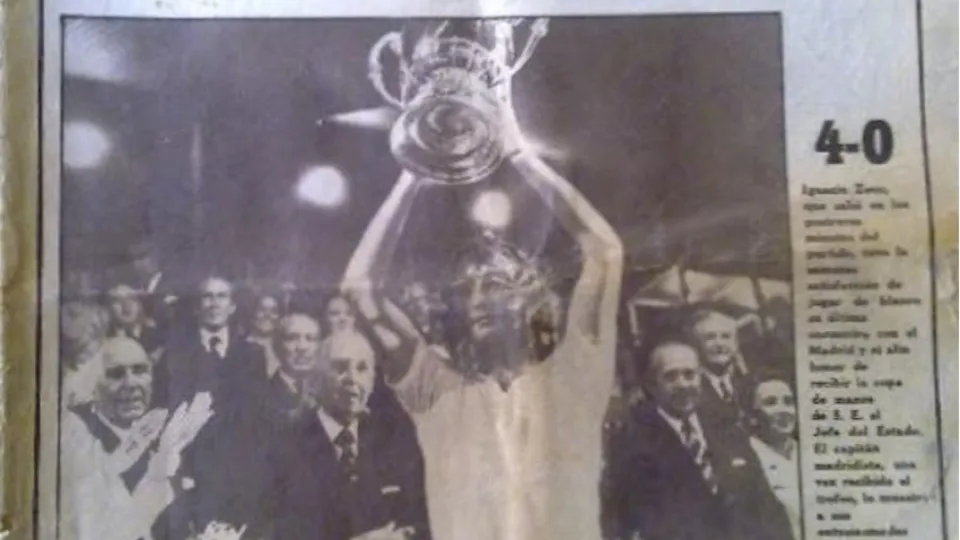
Zoco, at the end of the match, could not contain his emotion: “I cried a lot. I didn’t expect all this, it’s too incredible for words, too beautiful to be true. It’s the most ideal farewell I could have hoped for. I leave Madrid with an open heart and with the memory of victory. I value the gesture that Grosso made for me by giving up the chance to collect the trophy and handing me the captain’s armband so I could go up and receive the Cup. Everything I’ve enjoyed I owe to my teammates.”
Molowny, who had replaced Miguel Muñoz on the bench, was carried on the players’ shoulders, and Amancio, who was on the bench on crutches, also received congratulations.
The newspaper Mundo Deportivo asked Prince Don Juan Carlos about the match: “We witnessed a great game and above all a wonderful spectacle to which both teams and the public, who never stopped cheering for their colours, contributed. Madrid’s victory cannot be disputed as they were the better team on the pitch, but it must be highlighted that Barcelona never gave up, even when the score was against them. On another note, the sportsmanship of both teams, who strove to win with all honour, must be highlighted.”
Match report Real Madrid: Miguel Ángel; José Luis (Touriño, m. 84), Pirri, Benito, Rubiñán; Grosso (Zoco, m.84), Del Bosque and Velázquez; Aguilar, Santillana, and Macanás. FC Barcelona: Sadurní; Rifé, Gallego, Juan Carlos, De la Cruz; Costas, Asensi, Marcial; Rexach, Clares and Juanito, Goals: 1-0. M. 5. Santillana. 2-0. M. 45. Rubiñán. 3-0 M. 52. Aguilar. 4-0 M. 84. Pirri. Referee: Sánchez Ríos, from the Andalusian College. Vicente Calderón Stadium, Madrid, 29 June (21:00) |
1983
The clásico won by Barcelona
It took 9 years for another cup final clásico, a Barcelona-Real Madrid, to take place again.
The Whites and Blaugrana met for the fourth time in a cup final after those of 1936, 1968 and 1974. It was on Saturday 4 June 1983 in Zaragoza, at the La Romareda stadium, with Madrid and Barça contesting a final to which both arrived without a chance of winning any other title: Madrid finished second in the League behind Athletic, Barça had finished fourth.
The Catalan team, who started the campaign coached by Udo Lattek who was replaced by César Luis Menotti, eliminated Celta de Vigo in the Last 16. The opponent in the quarter-finals was Javier Clemente’s Athletic Club and in the semi-finals another Basque club, Real Sociedad.
Madrid, on their side, saw off two Andalusian teams (Cádiz and Sevilla) and in the semi-finals destroyed Sporting de Gijón (6-0 and 0-4), a team that had been finalists in 1981 and 1982.
Barcelona, strongly supported by a majority of culé fans, had Diego Armando Maradona as their star. El Pelusa and Schuster brought danger to the area of a great Miguel Ángel.
From the Argentine came the move and pass that Víctor Muñoz converted into the first goal in the 32nd minute.
Menotti went for an attacking strategy, placing Carrasco and Marcos on the wings, Esteban as a false centre forward and Maradona as the attacking midfielder. Di Stefano, Madrid’s coach, opted to be more cautious with two strong man-marking defenders (Bonet and Metgod) tasked with nullifying the Argentine star.
Madrid managed the equaliser after the break, following a mistake by Gerardo in defence, which allowed Santillana to push the ball into the net.
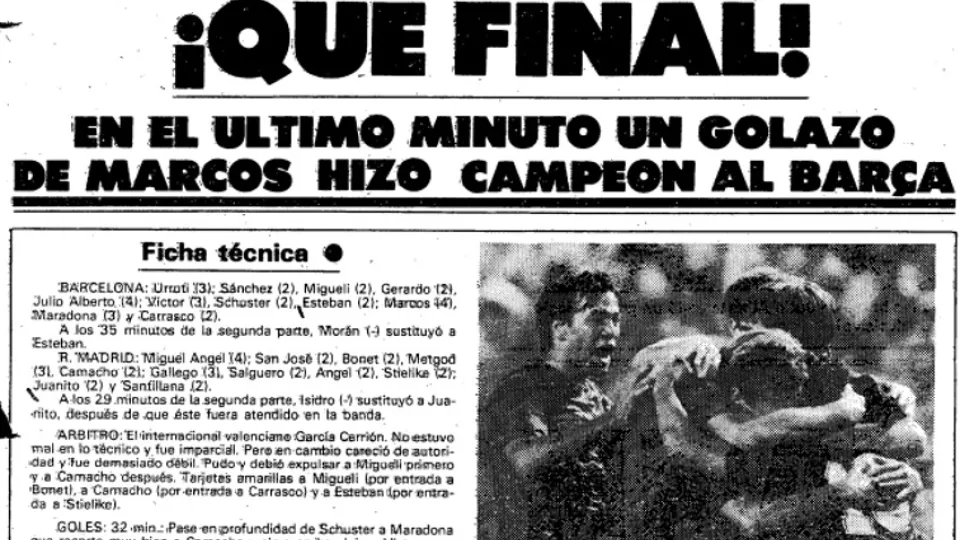
Everything pointed to the match going to extra time, but in the last minute, a cross from Julio Alberto, who got past Salguero in style, was turned into a goal by Marcos Alonso, with a beautiful diving header.
The goalscorer recalled that “it was a sensational match. The hallmark of it was Maradona and Schuster. I was lucky enough to score a goal in the last minute, and a very beautiful goal too.”
That year, Real Madrid would be nicknamed “the team of the five runners-up”, as they finished second in the League, Copa, Copa de la Liga, Cup Winners’ Cup (lost the final to Aberdeen) and Spanish Super Cup (against Real Sociedad).
“They simply scored in the last minute and that’s how we lost the match when shortly before we had had two clear scoring opportunities, one from Isidro and another from Angel and they were vital for us. Imagine, with a one-goal lead in the few minutes remaining if we had taken advantage of those chances, surely the win wouldn’t have slipped away,” reflected Di Stefano at the end of the match.
Thus Barça claimed their twentieth Copa del Rey title in the first season with Diego Armando Maradona.
The anecdote of the match was the timing in which it was played. It was played very late, at 22:15, as the RFEF agreed to delay the time so that a basketball match could first be shown on television and then the match between Madrid and Barcelona. That day at half-past eight, Spain’s basketball team under Antonio Díaz Miguel played Italy in the final of the European Basketball Championships.
In the royal box for the first time were members of a Socialist government accompanying the King: in attendance were the Deputy Prime Minister, Alfonso Guerra; the ministers Javier Solana (Culture), Carlos Solchaga (Industry), Ernest Lluch (Health) and Javier Moscoso (Presidency), as well as the President of the Generalitat of Catalonia, Jordi Pujol.
Match report Real Madrid CF: Miguel Ángel; San José, Bonet, Metgod, Camadho; Gallego, Salguero Ángel, Stielike; Juanito (Isidro, m. 80) and Santillana Referee: García Carrión |
1990
The first cup of Johan Cruyff’s Dream Team
The 90s began with a clásico: the final brought together Real Madrid, reigning champions, and FC Barcelona. The Blaugrana side, then managed by Johan Cruyff, and the Whites at the time under John Toshack, faced off. The match itself marked the end of the hegemony of the Quinta del Buitre and the beginning of the reign of the Dream Team.
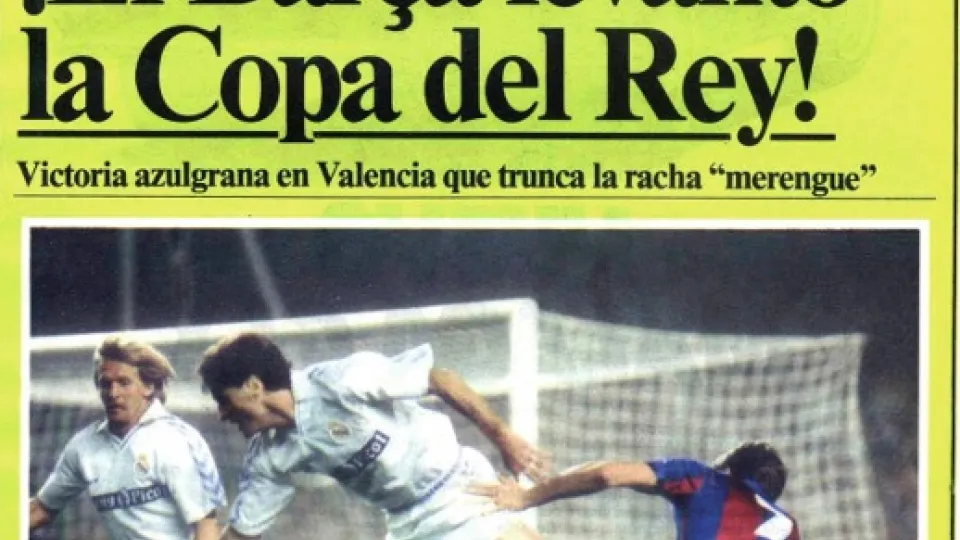
It was the fifth clásico between blancos and culés in a cup final after those of 1936, 1968, 1974, and 1983. Of those four finals, two had been won by Barça and the other two by Real Madrid.
The Azulgranas began their journey to the final on Thursday, 5 April 1990, in Valencia, eliminating Athletic in the Last 16. The Basques were defeated in the first leg (0-1) and the second leg (1-0), thanks to two penalties scored by Ronald Koeman. In the quarter-finals, they faced Real Sociedad. After winning the first leg 0-1 with a goal from Julio Salinas, in the Camp Nou second leg, Barça qualified in extra time after the 90 minutes ended 2-3. In the semi-finals, Barcelona defeated Valencia. In the first leg, Barça had to come back from a 0-1 deficit thanks to a penalty goal by Koeman and a goal from Roberto (2-1). And in the second leg, the Dutch centre-back equalised from a direct free kick ten minutes from the end (1-1), which put the Azulgranas into the final.
In Barcelona, there was a feeling that losing the final would mark the end of the project led by Cruyff. Alexanco even said he didn't understand why, if they lost, "the world would end." Madrid arrived as favourites with Hugo Sánchez as the attacking reference point. The Mexican, before the match, made clear the idea that hovered over the game about the presumed superiority of Madrid: "The Cup will serve us to toast to the League success."
The path of Real Madrid to the final involved eliminating Atlético Madrid in the Last 16, Valladolid Deportivo in the quarter-finals, and Cádiz in the semi-finals.
The final, exciting and full of chances , was marked by Fernando Hierro's expulsion for a second yellow card just before half-time. The Málaga-born central defender received his first yellow in the 25th minute for a tackle on Laudrup and the second in the 45th minute for a challenge on Roberto.
Earlier on, there were great opportunities for both sides: Butragueño missed alone in front of Zubizarreta, and Hugo Sánchez also failed to convert the chances he had. On his part, a good shot by Amor was masterfully stopped by Buyo.
Despite playing with fewer men, Madrid resisted the Barça onslaughts thanks to the fine interventions of the Madrid goalkeeper, Paco Buyo. However, the game started to turnwhen Guillermo Amor scored the 1-0 in the 68th minute, heading in a pass from Beguiristain in the area. And Julio Salinas made it 2-0 to kill the match in injury time.
The victory for Barça in the cup final saved Cruyff’s project, as Julio Salinas later acknowledged in an interview with the newspaper As: “It’s the clásico I remember with most affection. There was great tension, plus what a Barça-Madrid entails. We were in a delicate moment because we were fighting to save the project. A defeat would mean Cruyff's dismissal and not continuing with that project that was producing such good results. Perhaps the current Barça owes a bit to that victory. The Cup served for Cruyff to continue, and the following season, they won La Liga, the Supercup, and a year later, the European Cup. It was the philosophy that went on to be continued for years to come. Today, it has been improved with Guardiola and a youth academy that keeps producing fruit. I think if we had lost that final, Cruyff would have been sacked, and another foreign coach would have come in. It would have meant starting from scratch.”
Match report F. C. Barcelona: Zubizarreta; Aloisio, Alexanko, Koeman; Eusebio, Amor, Bakero, Roberto, Laudrup; Julio Salinas and Beguiristain. Substitutions: In the 28th minute, Aloisio, injured, was replaced by Serna and in the 70th Soler came on for Amor. Real Madrid CF: Buyo; Chendo, Hierro, Sanchís, Ruggeri, Gordillo; Michel, Schuster, Martín Vázquez; Butragueño and Hugo Sánchez. Substitutions: In the 62nd minute, Julio Llorente came on for Butragueño and in the 77th Aldana replaced Michel. REFEREE: Raúl García de Loza (Galician College) 1-0 68th minute Amor; 2-0 92nd minute Julio Salinas Luis Casanova (full capacity). Thursday, 5 April 1990 (8:00 pm) |
2011
Cristiano Ronaldo gives Madrid their 18th cup in a win over Barcelona
José Mourinho’s Real Madrid won a Copa del Rey in 2011 that had eluded them for 18 years: the last Madrid title had been in 1993. They did it against FC Barcelona thanks to a goal from Cristiano Ronaldo.
The team from Chamartín defeated, on their way to the final, Real Murcia, Levante, Atlético Madrid, and Sevilla in the semi-finals. Ceuta, Athletic, Betis, and Almería were the opponents of the Catalan team.
The match featured two very different halves but with a common denominator, great play and vibrant spectacle. Madrid dominated in the first half and the Catalans in the second.
The Madridistas had up to four clear chances (three from Cristiano and one off the post by Pepe) in the first half. In the second, FC Barcelona posed much danger with Pedro and Villa as their main threats. Opportunities piled up for Barcelona, who hit the woodwork twice against a great Casillas, against whom Messi, Iniesta, and Pedro could do nothing, and a goal by Undiano Mallenco was disallowed for offside.
The game was decided in extra time with a magnificent header from Cristiano, ending Madrid’s eighteen-year drought in the cup. It was José Mourinho’s first trophy with Madrid and the first final in which Pep Guardiola experienced defeat.
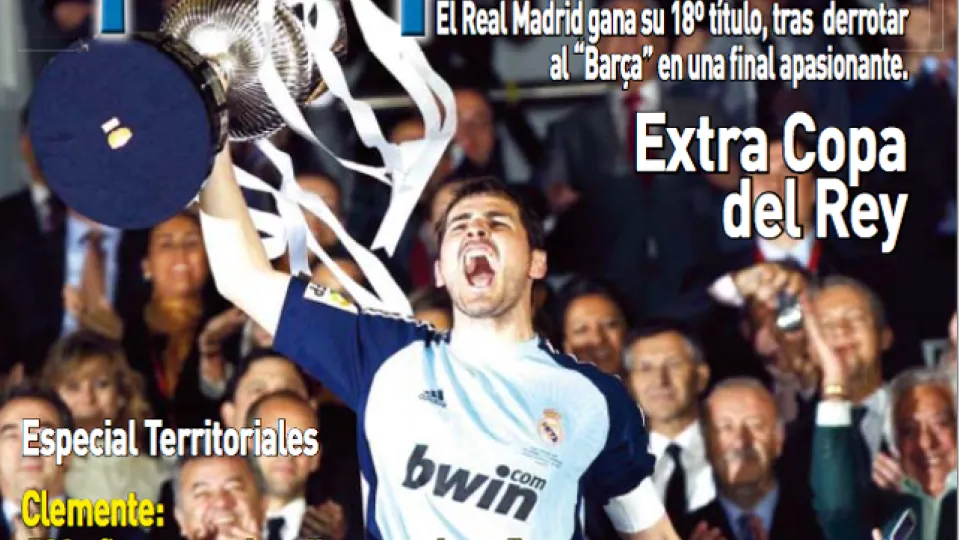
Luis Arnaiz summarised in the magazine Fútbol of the RFEF what was experienced on the Mestalla pitch: “Real Madrid won their 18th Copa de España in Valencia. They achieved it with their style of football, which is different, which is what it is, that pleases their fans, they say, and upsets almost all who are not their own, but which was much better and more practical at Mestalla than in Madrid. There is nothing questionable in that sense. This sport is played in many ways, and Madrid’s style against the Azulgranas is what it is. Their victory was impeccable (unfortunately for some, the refereeing was impartial and excellent) and unquestionable, just as FC Barcelona’s would have been if they had managed to take advantage of their superiority when they clearly dominated the pitch. But only one wins a final and there is no reproach to Madrid’s eighteenth cup success. They used their best weapons admirably and earned the rewards. Everyone plays with the cards they have and uses them as best they can. And in Valencia, that worked out magnificently.”
The match was a duel of benches and styles: between Guardiola, who until then had not lost a final, and Mourinho. The Catalan admitted the blow but encouraged his team: “It’s always better to win than to lose, that’s obvious, but life is like that. We can’t always win. We will get back up, of course. These players have got back up many times before.”
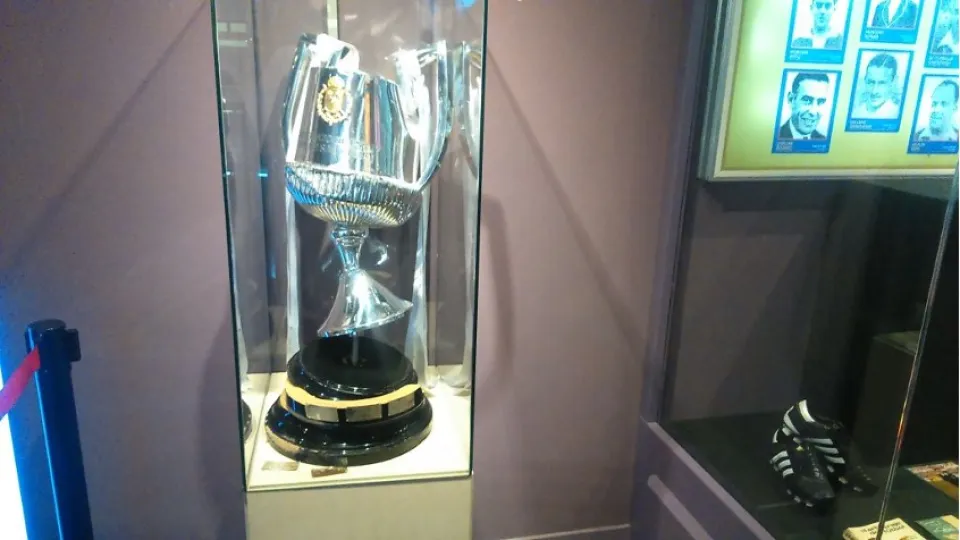
The anecdote of the final came during the post-match celebration, around 04:15, when the open-top bus of Real Madrid arrived at Cibeles to celebrate the cup victory. Then, Sergio Ramos, who was holding the trophy in his hands, lost his grip and the trophy fell to the ground, and unfortunately the bus ended up crushing the cup.
The trophy can be seen in the RFEF Museum
Match report FC Barcelona: Pinto; Alves, Piqué, Mascherano, Adriano (Maxwell, m.119); Xavi, Busquets (Keita, m.108), Iniesta; Pedro, Messi, and Villa (Afellay, m.105). Real Madrid CF: Casillas; Arbeloa, Sergio Ramos, Carvalho (Garay, m.119), Marcelo; Pepe, Xabi Alonso, Khedira (Granero, m.104), Ozil (Adebayor, m.70); Cristiano Ronaldo and Di María. 0-1, 103rd minute: Cristiano Ronaldo Referee: Alberto Undiano Mallenco (Navarre Committee). Booked for Barcelona: Pedro (34th minute), Messi (64th minute), and Adriano (118th minute); for Real Madrid: Pepe (26th minute), Xavi Alonso (60th minute), and Adebayor (74th minute). Expelled for two yellow cards, Madrid’s Di María (86th and 120th minute). Mestalla (50,000 spectators). Wednesday, 20 April (9:30 pm) |
2014
The cup of Gareth Bale’s stunning goal
In cup finals, there have been goals that have gone down in history and become fixed in collective memory. And that’s what happened in the great 2014 encounter when Gareth Bale scored an unforgettable goal (after a solo run of more than 50 metres) that earned Madrid the trophy against their eternal rival, FC Barcelona.
It was the seventh Copa del Rey final between Madrid side and Catalans in the entire history of the competition, matches that up to that point had resulted in three wins for each team. Madrid victories in 1936, 1975, and 2011, and Azulgrana victories in 1968, 1983, and 1990. It was also the first time in a decade that both teams faced each other in two finals.
The Whites, managed by Carlo Ancelotti and without Cristiano Ronaldo, faced a Catalan team led by Tata Martino, who was missing Víctor Valdés, Puyol, and Piqué.
Cartagena, Getafe, Levante, and Real Sociedad were the victims of the Catalans on their way to the final. To reach this stage, Madrid had overcome Olimpic de Xàtiva, Osasuna, Espanyol, and Atlético Madrid.
At the grand venue of Mestalla, Madrid opened the scoring early (in the 10th minute through Di María) and managed to hold that lead thanks to their good tactical deployment and a great Casillas who, among other chances, saved a powerful shot from Bartra. Shortly after this, however, the azulgrana central defender headed the equaliser in the 68th minute.
Then came the climax, when Bale, the most dangerous and incisive man in that final, put the finishing touch to the final. The Welshman, who covered the 59.1 metres to the goal in just 7.04 seconds, acknowledged that it was “the goal of my life. I scored a similar goal with Wales not long ago. I had to run off the pitch, trying to dodge (Marc) Bartra and in the end, I managed to do it. Fortunately, the goal came at the end of the play. I literally had to go around him, but I was only focused on the ball. He tried to block me by pushing me, but he couldn’t. I wasn’t looking back to see if he was following me. I was only focused on the ball.”
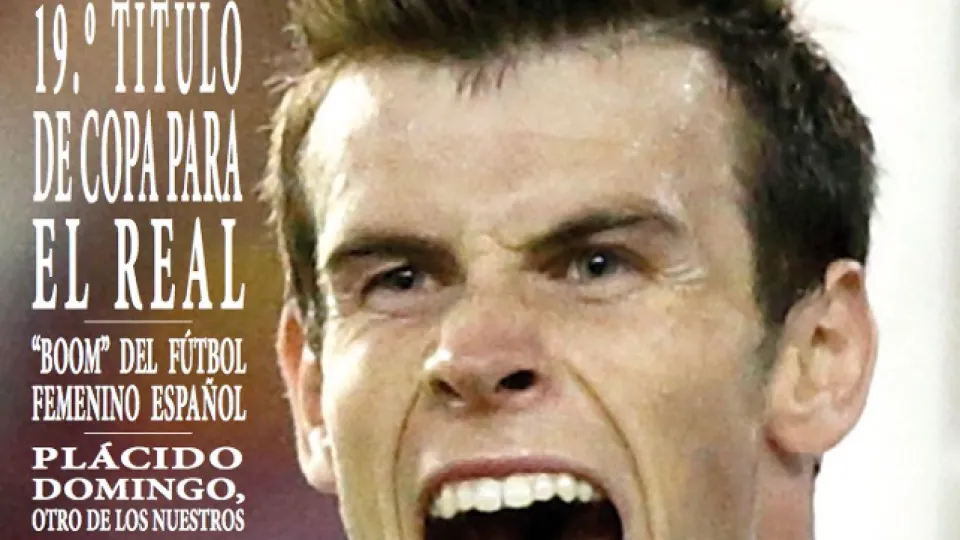
It was the nineteenth cup for the Whites, who played on the counterattack and relied on their pace against the Blaugrana’s style.
It was the last cup handed out by King Juan Carlos, who two months later abdicated in favour of his son Felipe VI. The monarch had been present at cup finals since 1970 and had been presenting trophies to the winner since 1976 (except for medical issues in 2010 and 2012).
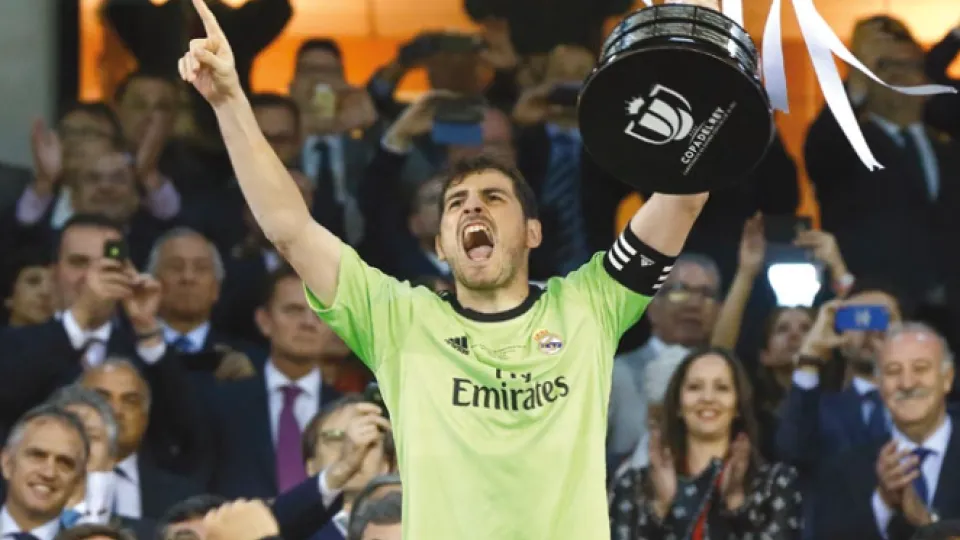
This was the tenth time Valencia hosted the cup final, making it the third city in terms of hosting finals, only surpassed by Madrid (64 editions up to 2014) and Barcelona, with 17.
Match report Real Madrid CF: Iker Casillas; Carvajal, Pepe, Sergio Ramos, Coentrão; Di María (Illarramendi, 86), Modric, Xabi Alonso, Isco (Casemiro, 88); Bale and Benzema (Varane, 90). 1-0, 11th minute: Di María. 1-1, 68th minute: Bartra. 0-2, 85th minute: Bale. Referee: Antonio Mateu Lahoz (Valencian Community Referee Committee) Booked: Isco, Neymar, Pepe, Mascherano, and Xabi Alonso. Mestalla (55,000 spectators). Wednesday, 16 April (9:30 pm) |