
The Iberian derby, a classic of world football
The early clashes, the start of Spanish dominance (1921–1945):
The first encounters between the two countries form part of a period of Spanish dominance, as between 1921 and 1945 Portugal not only failed to win a single match but also suffered historic defeats.
The first time they met was in 1921. In December, at the O'Donnell stadium in Madrid, the national team beat Portugal 3-1, with two goals from Alcántara and a magnificent header from Meana, assisted by Pagaza.
Almost 30 years later, one of the debutants against the Portuguese, Luis Olaso (Athletic Club de Madrid), recalled in Marca some anecdotes surrounding that match, describing what football was like in those days and the difficulties the national team faced in functioning as a team. For example, in 1949 he recounted that in the 1920s there were no training camps: “That’s a modern approach. We each stayed at home except for those selected from the provinces, who stayed at the Hotel Londres.”
Preparation for matches was very limited: “There was only one training match against a Castilian selection, which we won 1-0… On another occasion, we did a few workouts and ball control drills,” he said.
In 1922 the first match on Portuguese soil was held. The trip to Lisbon became a clear reflection of the conditions under which players travelled and what it meant to be an international player in those times:
“I remember,” said Olaso, “that when we returned the visit, we travelled on the train freezing cold, huddled around the heating boilers. The accommodation was very basic. Sometimes two players had to share a bed. On that occasion, some teammates arrived before me and took the beds, so I had to sleep on a folding chair, with my socks on because my feet were hanging off.”
The year 1925 began with a trip to Portugal, where Spain won 0-2 with goals from Carmelo of Bilbao and Óscar of Santander. That match included a story later recalled in 1951 by then coach Félix Quesada, who had played in the game against Portugal. When the Portuguese were attacking the most, the referee signalled for a corner. As he went to blow the whistle to resume play, something unpleasant came out of his nose, and the Andalusian international Herminio said: “Maestro! Your talent is dripping out.” In Lisbon, goals from Piera and Monjardín established Spain as the dominant force in Iberian football.
In 1927, a rare case occurred in the history of the national team (though it would happen again in 1949): Spain played two matches on the same day. In Madrid, the national team faced Portugal in the presence of King Alfonso XIII (and Princes Don Juan and Don Jaime) in the royal box; meanwhile, another team played against Italy in Bologna – the RFEF only considers the match against the Italians official. In the Spanish capital, the national team won 2-0 (goals by Valderrama and Moraleda), while in Bologna, they lost 2-0. The Estadio Metropolitano saw a “B team” debut for future coach Guillermo Eizaguirre.
Lángara’s five goals:
The most memorable match of that period took place in 1934 at the Chamartín Stadium, where Spain thrashed Portugal 9-0, with five goals from Isidro Lángara. To reach the 1934 World Cup, Spain had to win a two-legged qualifier against Portugal. In Madrid, Spain beat the Portuguese 9-0 (a match attended by the President of the Republic, Niceto Alcalá-Zamora), and in the neighbouring country, the team led by García Salazar secured a narrower 1-2 win. The performance in Chamartín was remarkable, with the match effectively decided within fifteen minutes thanks to a goal from Chacho and two from Lángara.
Spain played very well, not only due to Lángara’s scoring ability (5 goals) and Luis Regueiro’s lethal contribution (2), but also due to the defensive strength of the Quincoces-Zabalo duo, the midfield coordination of Marculeta and Cilaurren with Regueiro and Chacho, the wing runs by Gorostiza and Ventolrá (who scored once), and Lángara’s powerful finishing.
The Iberian balance evens out (1945–1984):
Portugal’s first win in the Iberian derby came in 1947, when they convincingly beat Spain 4-1 at the National Stadium in Jamor. Losing to the Portuguese often meant the coach’s dismissal. The tenure of manager Hernández Coronado left behind a national team struggling with poor results and low confidence. The coach himself described his time in charge as “disastrous.” “Because during my first spell as manager, we lost for the first time in our history to Portugal in 1947,” he explained.
The balance in Iberian clashes began to even out in 1958. From that point, Spain went 45 years and eight matches without beating Portugal. One such match took place in the group stage of Euro 1984, ending in a 1-1 draw.
A derby of equals (2003–2025):
The drought ended in 2003 with a 0-3 Spanish victory in Guimarães, with goals from Joseba Etxeberría, Joaquín Sánchez, and Diego Tristán.
However, a year later, Portugal got their revenge with a goal by Nuno Gomes in the final group stage match of Euro 2004 – a goal that eliminated Iñaki Sáez’s Spain from the tournament.
It would be six years before another Iberian derby, when a goal from David Villa helped “La Roja” defeat Portugal 1-0 in the Last 16 at the 2010 World Cup.
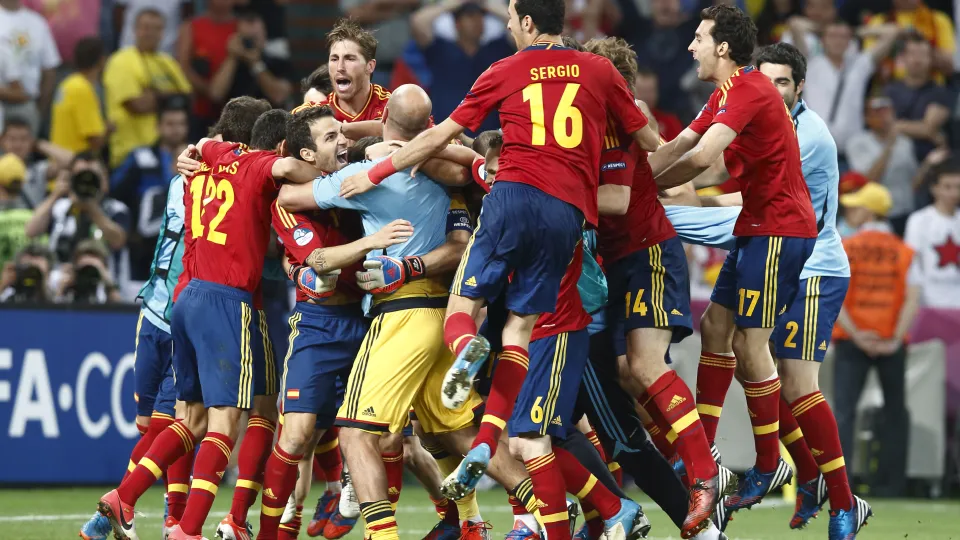
The Euro 2012 semi-finals saw another top-level clash between the two teams, a match that remained 0-0 after extra time.
Against Portugal, in the semi-finals, two more heroes emerged in the penalty shootout. First, Casillas played a decisive role, saving Joao Moutinho’s penalty right after Xabi Alonso had missed his own.
Then Cesc Fàbregas showed he was in good form, scoring the penalty that sent Spain to the final: “I had this feeling. I was thinking about it this afternoon. Toni (Grande) told me to take the second penalty and I said no. I had this feeling. Life gives me another chance like this and it’s incredible.” Just like four years earlier in the European Championships quarter-finals against Italy. Cesc repeated and scored the final goal to reach the final. “Cesc told me he preferred to take the fifth, the one to win us the match. He’s one of the most reliable penalty takers and we had him listed second. We’re not going to argue about it,” said Vicente del Bosque after the match.
Since then and up to 2025, they have faced each other five times – two friendlies and three official tournament matches.
| DATE | COMPETITION | RESULT |
15 June 2018 | World Cup | Portugal 3 - 3 Spain |
7 October 2020 | Friendly | Portugal 0 - 0 Spain |
4 June 2021 | Friendly | Spain 0 - 0 Portugal |
2 June 2022 | UEFA Nations League | Spain 1 - 1 Portugal |
27 September 2022 | UEFA Nations League | Portugal 0 - 1 Spain |
There have been four occasions when both national teams have faced each other in the final stages of European Championships or World Cups.
These encounters have been extremely evenly matched, with Portugal winning one match (at Euro 2004), Spain claiming victory in another (at the 2010 World Cup), and two draws at the end of regular time (in the 1984 and 2012 European Championships).