

The Spanish Football Crisis Committee meets at the RFEF to discuss reconstruction and aid for the sport in the areas affected by recent flooding.
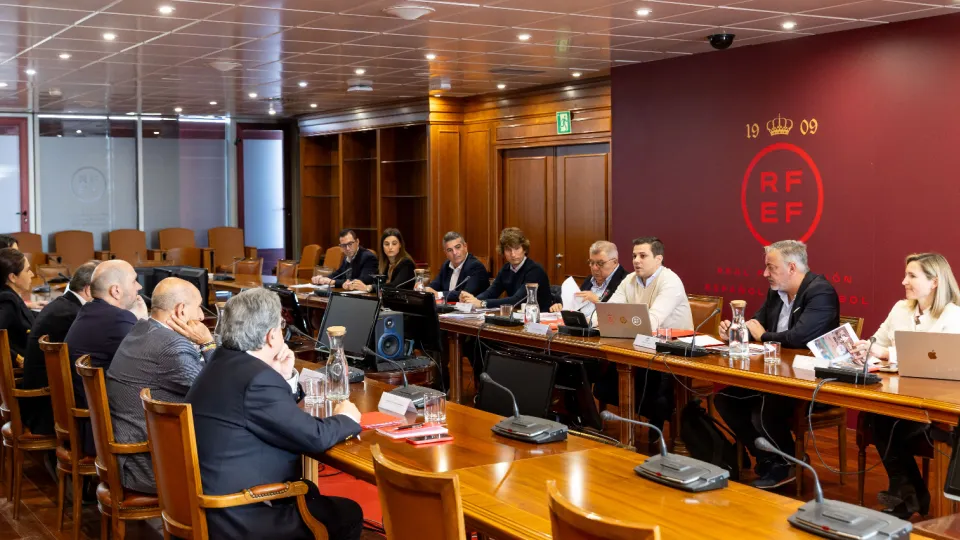
- The RFEF, LALIGA, Liga F, AFE and Futpro have drawn up specific actions to firm up this collaboration, which include the restoration of pitches and sports halls where football is played, which were destroyed.
- A total of 37 facilities have been damaged in Valencia, 15 of which are devastated football pitches, and more than 20,000 official competitors have been affected.
- Travel and refereeing costs are to be compensated for teams in the affected areas.
The Spanish Football Crisis Committee has met today at the RFEF to discuss the analysis, reconstruction and aid for the sport in the areas affected by the storms and resulting floods, especially in Valencia, where up to 37 facilities have been damaged, 15 of these football pitches have been totally devastated.
Representatives of the RFEF, LALIGA, Liga F, AFE and Futpro established a concrete timetable, with specific actions to achieve this objective, after hearing reports on the situation in these municipalities from the president of the Football Federation of the Valencian Community, Salvador Gomar; and the president of the Football Federation of Castilla La Mancha, Pablo Burillo.
While in Castilla La Mancha the most affected level of our sport has been school football, in the case of the Community of Valencia the damage is varying in nature, affecting a total of 20,000 federal football licences holders (more than 15 percent of Valencian football) and more than 21,000 fixtures. An on-site in-depth survey of each of these facilities, some of which are owned by the federation and others by the municipality, will be carried out, in order to then shape the reconstruction.
As an immediate measure, the travel and refereeing expenses of all the teams in the affected areas will be compensated. As it happens, competitions will start this week in Valencia where possible.
RFEF general secretary Álvaro de Miguel detailed the nature of the meeting. ‘It is not just another committee meeting. We have the responsibility to stand shoulder to shoulder with the victims and we must restore optimism and enthusiasm for the sport. For its part, LALIGA, in the words of Victor Martin, stressed the importance of the cordial relationship between all football stakeholders to find solutions. ‘It is something we cannot waste,’ he said, after recalling that LALIGA has a real will to collaborate technically and economically.
The AFE representative, Manuel Tello, provided the proposed protocol to activate this entity in possible new existing crises and insisted ‘on the need for all operators in the world of football to be involved in any decision that is adopted in any crisis and that all of them are agreed’. Liga F, with Pablo Vilches, also considered this proposal to be fundamental, as well as organising the actions so that there is always constant coordination between all the entities in Spanish football.
For its part, Futpro, with Reyes Bellver, made female players available to collaborate on charitable issues, stressed the importance of the gender perspective in all actions carried out and to support team transfers and offer psychological help.
The meeting was also attended by the vice-president of the RFEF, Rafa Louzán; the president of Social Responsibility, Jacinto Alonso; and the director of Equality, Social Responsibility and Sustainability, Marisa González; as well as other representatives of the RFEF and LALIGA.