Spain and France, old foes
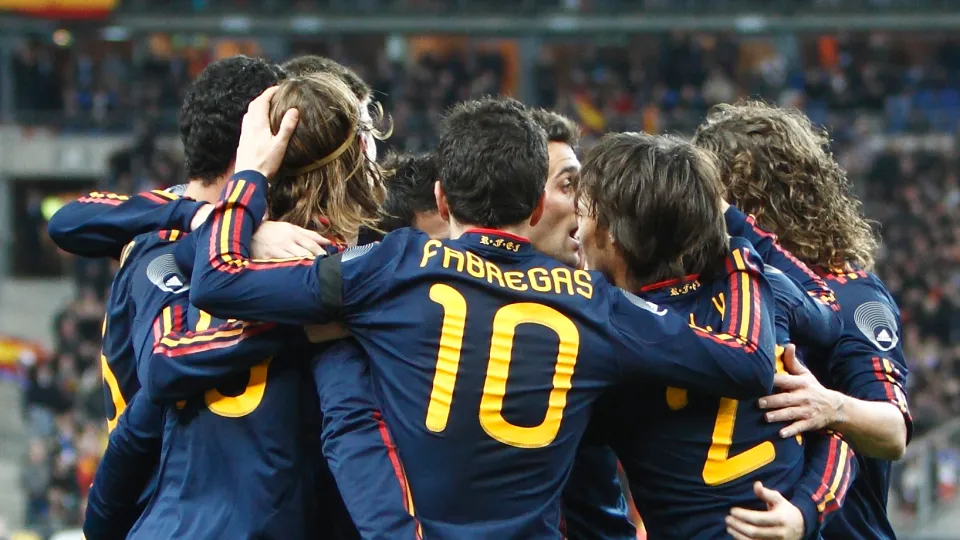
Spain and France are two old foes, having first met in 1922. Since then, they have played each other on 37 occasions, although only since 1984 have they met in official competitions.
| Matches | 37 |
| Spain wins | 17 |
| France wins | 13 |
| Draws | 7 |
Spain goals | 66 |
| France goals | 40 |
The period of Spanish dominance (1922–1949)
Between 1922 and 1933, the upper hand was clearly Spanish, and during this period France even suffered several thrashings. In 1922, the Bouscat Stadium in Bordeaux hosted the first Franco-Spanish clash. The national team sealed a resounding victory thanks to two goals from Travieso and another two from Paulino Alcántara.
In 1923, another convincing win was added (3–0 in Atocha with two goals from Monjardín and one from Zabala). The famous Spanish fury remained the key to these victories, which, however brilliant, did reveal certain issues, as noted by the newspaper Jornada Deportiva: “We Spaniards have no tactics whatsoever. Everything that happens on the pitch is the result of feverish improvisation; but as Latin improvisation, rich in... resources... their tactic is to have no tactic.”
Following the 1–4 of 1927 (two goals from Zaldúa and one each from Termo and Olaso), Spain achieved their biggest win. Spain defeated France with a resounding 8–1 at the old El Torrero ground in Zaragoza. Real Madrid striker Gaspar Rubio dazzled once again (4 goals), along with Bienzobas (2) and Goiburu (2).
| 30/04/1922 | Friendly | Spain 4-0 France |
| 28/01/1923 | Friendly | Spain 3-0 France |
| 22/05/1927 | Friendly | France 1-4 Spain |
| 14/04/1929 | Friendly | Spain 8-1 France |
In the 30s and 40s, Spain were once again vastly superior – only suffering defeat in 1933 – and some of those matches, despite being friendlies, marked a turning point for the Spanish national team. Before the Civil War, the team was strong, having impressed at the 1934 World Cup and potentially capable of great things in 1938. Evidence of this came in the 2–0 win over France in Madrid in 1935, with goals from Luis Regueiro and Hilario.
In 1942, in the midst of the Second World War, with Eduardo Teus in charge, the national team played three more international matches: against France, Germany and Italy. The first opponents were the French national team, the France of Vichy and Marshal Pétain. On 14 March, the French delegation arrived in Spain, accompanied by Jules Rimet (who was not only president of FIFA but also of the French Federation). Teus, with the assistance and collaboration of Ricardo Zamora, wrote an article in Mundo Deportivo warning of the dangers posed by the excess of euphoria that had begun to surround the Spanish team following good results the previous year. Spain comfortably beat France 4–0 with goals from Campos (two), Mundo and Epi.
The next meeting with France came as Spain were preparing for the 1950 World Cup in Brazil. The friendlies had been going poorly until France came along. Up to that point, the national team had failed to impress, despite some decent results: they had played poorly (against Ireland), their football had been uninspiring (against Switzerland and Portugal), or they had simply disappointed, particularly against Belgium and especially against Italy. By mid-1949, however, the work being done began to take shape and the definitive foundations were laid for the project that would shine in Brazil at the 1950 World Cup. Behind this change was, firstly, the arrival of Benito Díaz as coach; and secondly, that the results began to follow as the new tactics became better understood.
The moment of truth
The stage of testing and grasping concepts was over; now it was time to apply what had been learned. Benito Díaz, nicknamed "Uncle Benito", was a firm believer in the WM formation and, for many, its introducer in Spain. If two matches marked a before and after in the national team’s history, they were the ones played in June 1949 in Dublin and Paris. It was a turning point not only because of the victory over Ireland (1–4) but because of how it happened: coming back from a goal down with goals from Basora, Zarra (two), and Igoa, and with spectacular football. Riding that wave of euphoria and improvement, the team travelled to Paris, where they trained at Saint Germain and Colombes with two secret weapons. The first was food – Díaz brought olive oil from Spain so that the players would not suffer from the change in diet. The second, in Díaz's own words, was “the bewildering speed, frequent shooting from any position, and a fury that we saw in Dublin has not disappeared”.
In Paris, the same players from Dublin were selected, with the addition of Panizo. Spain won convincingly, emphatically and brilliantly (1–5): three goals from Basora and two from Gainza, who also provided two assists to the Barça winger. The latter, having already scored in Ireland, took full control of the right flank for the national team after his outstanding performance on French soil. Basora, in just 12 minutes, completed his hat-trick, and the French press dubbed him the “monster of Colombes”. Basora did not hesitate to celebrate his success, as he later admitted: “You don’t sleep in Paris, especially not after such a resounding international victory.” The forward line was made up almost entirely of Athletic Club players (Venancio, Zarra, Panizo and Gainza), with the sole exception of Basora on the right wing. The spine of the team came from Valencia, with Eizaguirre in goal, Asensi in defence and Puchades in midfield, partnered by Barça’s Gonzalvo III. Among the rest of the players who featured in Colombes, Sevilla’s Antúnez stood out in defence alongside Lozano of Atlético Madrid.
Paris had confirmed what had started in Dublin: this was a different Spain, and one of the main architects had a name. In Marca, former national coach and journalist Melcón noted: “No more solo artists… Now, it’s about the team… playing connected football… Benito Díaz has, in a short time, made a huge contribution to Spanish football.” The players even lifted the coach on their shoulders, and Eizaguirre did not hesitate to single him out as the driving force behind the transformation: “The one who deserves everything here is Benito Díaz… he alone is the one who has changed Spanish football. A brilliant technician and an excellent coach!”
| 23/04/1933 | Friendly | France 1-0 Spain |
| 24/01/1935 | Friendly | Spain 2-0 France |
| 15/03/1942 | Friendly | Spain 4-0 France |
| 19/06/1949 | Friendly | France 1-5 Spain |
From parity to the birth of the French curse (1950–1984)
Parity between Spain and France was the dominant trend from the 1950s to the 1980s, until the final of the 1984 European Championships, when the so-called French curse began — a streak that would end in 2012. During those years of balanced results, with numerous draws and victories for both the French and the Spanish, one standout match was the 1958 clash at the Parc des Princes, which ended in a 2–2 draw and was the first to be broadcast by RTVE.
Another 2–2 draw came in 1971, with a brace from Pirri at La Mestalla. But 1984 was the key year. Spain and France met in an official tournament for the first time in history. After qualifying for the European Championships in France by defeating Malta 12–1, the Spanish national team had a great tournament, reaching the final where they faced the hosts. A formidable French side (Bats; Battiston, Le Roux, Bossis, Domergue; Luis Fernández, Tigana, Giresse, Platini; Lacombe and Bellone) playing in their favourite location, Paris. Spain held off the tricolore for nearly an hour, thanks in part to Camacho's tight marking of Platini. But in the 57th minute, the first French goal arrived when Arconada mishandled a shot; and in the 90th, Bellone made it 2–0.
Spain’s dream of repeating what had been achieved two decades earlier faded. Miguel Muñoz, who did not lose his sense of humour despite the defeat, commented: “The flower has wilted, bloody hell!” The national team, in any case, had made the definitive leap to the elite by reaching a European Championships final — something that would be confirmed two years later at the 1986 World Cup in Mexico, where they reached the quarter-finals.
| 17/03/1955 | Friendly | Spain 1-2 France |
| 13/03/1958 | Friendly | France 2-2 Spain |
| 17/12/1959 | Friendly | France 4-3 Spain |
| 01/04/1961 | Friendly | Spain 2-0 France |
| 10/12/1961 | Friendly | France 1-1 Spain |
| 09/01/1963 | Friendly | Spain 0-0 France |
| 17/10/1968 | Friendly | France 1-3 Spain |
| 17/03/1971 | Friendly | Spain 2-2 France |
| 08/11/1978 | Friendly | France 1-0 Spain |
| 18/02/1981 | Friendly | Spain 1-0 France |
| 05/10/1983 | Friendly | France 1-1 Spain |
| 27/06/1984 | Euro 1984 | France 2-0 Spain |
After the Paris final, France became Spain’s nemesis. First, the French knocked Spain out of Euro 1992 in the qualifying phase, where both teams were drawn in the same group. In Belgium and the Netherlands in 2000 and in Germany 2006, France eliminated Spain from the European Championships and the World Cup in the quarter-finals and Last 16 respectively.
At Euro 2000, France, reigning World Cup winners, awaited in the quarter-finals with a great group of players. Bruges, with a majority of Spanish fans in the stands, saw Spain put in a good performance against their toughest opponent — a France lead by Zinedine Zidane, who opened the scoring. The goal did not sink Spain, who gradually gained control of the match when Helguera and Guardiola began to dominate the midfield. It was Pedro Munitis who earned a penalty after a challenge from Laurent Blanc, and Mendieta stepped up to take and score it. The scoreline lasted barely five minutes before a fine move from Djorkaeff, who beat Cañizares with a powerful strike. Hope returned in the final minute. Barthez committed a foul on Abelardo, giving away a penalty which Raúl stepped up to take. He sent the ball into the Bruges sky — and with it, Spain’s hopes of a 2–2 draw and extra time. A miss that brought Raúl to tears: “I was convinced I would equalise. I cried on the pitch, I cried in the dressing room, and I cried at the hotel. I was carrying it inside and I needed to let it out.”
In 2006, France knocked Spain out of the World Cup in Germany with a 3–1 victory. David Villa had put Spain ahead with a penalty, but Franck Ribéry, Patrick Vieira and Zinedine Zidane turned it around for France. “France taught us a lesson that day which helped us grow,” Fernando Torres would later recall.
| 23/03/1988 | Friendly | France 2-1 Spain |
| 20/02/1991 | European Championships qualifying | France 3-1 Spain |
| 12/10/1991 | European Championships qualifying | Spain 1-2 France |
| 15/06/1996 | Euro 1996 | France 1-1 Spain |
| 28/01/1998 | Friendly | France 1-0 Spain |
| 25/06/2000 | Euro 2000 | France 1-2 Spain |
| 27/06/2006 | World cup | France 3-1 Spain |
| 03/03/2010 | Friendly | France 0-2 Spain |
The new Spanish dominance over France (2012–2024)
The French curse ended in 2012. Spain advanced to the semi-finals of a European Championships they would go on to win, thanks to two goals from Xabi Alonso against France, in what was the Basque player’s 100th appearance for the national team. Later, to qualify for the 2014 World Cup, Spain needed to beat France away. A goal from Pedro Rodríguez gave Del Bosque’s team a crucial victory at the Stade de France, securing their path to the World Cup in Brazil.
The only defeat in an official tournament in recent years came in the final of the Nations League in 2021. In an exciting match, France came out on top with goals from Karim Benzema and Kylian Mbappé, securing the Nations League title. Mbappé’s goal was confirmed by VAR after it was deemed that Eric Garcia’s attempted clearance created a new phase of play, despite the PSG player being clearly offside. Spain, who had taken the lead through a goal from Oyarzabal, played well but failed to take their chances.
But Spanish revenge would arrive in 2024, when Spain, with goals from Lamine Yamal and Olmo and with the midfield orchestration of Rodri, defeated France 2–1 and reached the final of the European Championships, which they would go on to win.
| 23/06/2012 | Euro 2012 | Spain 2-0 France |
| 16/10/2012 | World Cup Qualifying | Spain 1-1 France |
| 26/03/2013 | World Cup Qualifying | France 0-1 Spain |
| 04/09/2014 | Friendly | France 1-0 Spain |
| 28/03/2017 | Friendly | France 0-2 Spain |
| 10/10/2021 | UEFA Nations League | Spain 1-2 France |
| 09/07/2024 | Semi-finals Euro 2024 | Spain 2-1 France |
More related news