
History of the Spanish National Team (Part 10): The Eizaguirre-Benito Díaz Revolution
After the Civil War that paralysed the country and divided our football too, and also after World War II, Spain progressively rebuilt itself as a National Team, with a period between 1945 and 1950 that one might refer to as a period of great hope. The situation between 1942 and 1947 has been previously described, and now it is time to address the three coming years, those between 1947 and 1950. These would be key in a period that would culminate in a fourth place finish at the World Cup in Brazil, providing the confirmation that the promise shown before the two wars could continue to grow and flourish.
By mid-1947 there was an urgent need to make profound changes in the national team. The reasons were many and varied:
- Firstly, instability in terms of the management, with three coaches in two years, between 1945 and 1947.
- Secondly, the team's defeats against Portugal and Ireland had shown that the Spanish style was becoming outdated.
- Finally, the superiority of other tactical approaches - such as those shown by teams like Argentina's San Lorenzo de Almagro and Brazil's Vasco de Gama in their visits to Spain - made it clear that technical, tactical and preparation changes were needed in Spanish football and in the national team setup.
The man called upon to modernise the national team tactically and introduce greater planning and continuity in their approach with the team was Guillermo Eizaguirre, who acted with the full support and in line with the changes introduced at the institutional level by Armando Muñoz Calero, president of the FEF.
The impact of the new coach could be felt very early on, especially in two very specific areas. When it came to providing the Spanish team with a well-structured training schedule, Eizaguirre took over in May 1947 and from October of that same year began to hold regular training camps for the internationals. These were held almost every 30 days, and sometimes twice in the same month. These meet ups included training sessions, squad training camps and matches between A and B teams or against other club or national teams.
In addition, Eizaguirre's arrival on the national team bench meant the introduction of changes in the way the team played, especially when it came to using the in vogue tactic at the time, the WM, a task for which he had the support of his coaches Moncho Encinas and Ricardo Zamora at first and then, even more so, from Benito Diaz. Eizaguirre, who had seen how the teams in Italy, England and France played and how they used these new tactics, began to place three defenders at the back and to use the inside players to support the two midfielders, forming a sort of "magic square" in the centre of the pitch.
Eizaguirre's period at the helm of the national team can be divided into two clearly marked stages. The first period (1947-49) of his tenure was marked by his work focused on instilling new tactical concepts in the internationals. The second (1949-50) was characterised by the successful implementation of these new approaches, which resulted in brilliant victories over Ireland, France and Portugal and in the great part played by the Spanish national team at the World Cup in Brazil.
At the first national team training camps of this new period, held in Barcelona and Madrid, Eizaguirre's circumstances became clear: his tactical commitment to the WM was hindered by problems of adaptation. This would be the main challenge for the Eizaguirre project in the 1948-1949 period: to get the national team used to the WM system.
Eizaguirre's work was supported initially by Ricardo Zamora and then, in January 1948, by Ramón Encinas, who came into the national team setup as a coach.
The first match for the Eizaguirre-Encinas partnership was decided in the same month of January 1948. After almost a year of preparation and training, it was time to see what the team was made of, to test what had been drilled into them and learned under Eizaguirre's guidance. On March 21, 1948, at 4:45 am, the Chamartín stadium, packed to the rafters with 85 thousand spectators in the stands, hosted the nineteenth Spain-Portugal match, which was attended by Franco in the box.
It was the first time that the Spanish national team applied the WM in an official match. After the feelings that came from a positive 2-0 victory over Portugal, Eizaguirre's work continued to focus on trying to perfect the adaptation of the internationals to the new strategy. The following matches against Ireland and Switzerland showed the difficulties and obstacles that the internationals had while trying to make the WM tactic their own.
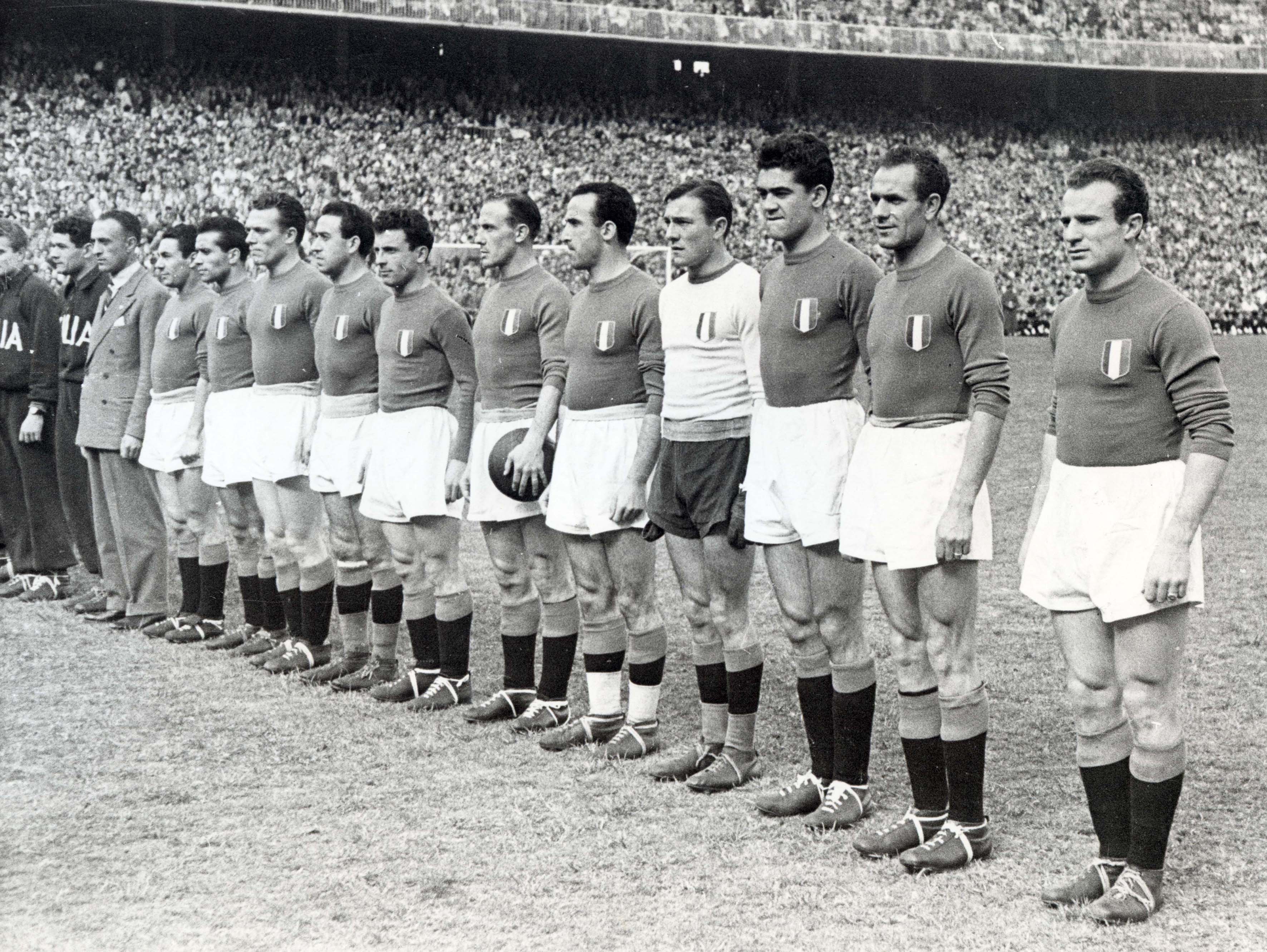
The 1949 team before playing Italy.
This WM tactic was once again tried out in the 1949 friendly match against Belgium, which ended in a 1-1 draw. With the team failing to put on a show, it caused whistles from a crowd that even ended up throwing stones onto the pitch, forcing the police to intervene.
Old rival Portugal became a yardstick to measure to what extent the team had or had not improved. The A team drew 1-1 in Portugal and the B team won 5-2 in Riazor. But more than the results, the important thing was that there was a certain feeling that a homogeneous unit with clearer tactical ideas was taking shape. And above all, in the Lisbon match the coach found his definitive partner for the midfield: the Valencian player Antonio Puchades made his debut and after two years of absence Gonzalvo III returned and made his place as his partner in midfield his own
After the improvement in performance shown in Lisbon, despite the 1-1 draw, came the bad experience against the next opponent, Italy.
Spain suffered a painful defeat against the Italians in Chamartín, losing 1-3, the Spanish goal scored by Gainza. The Spanish magic square in the centre of the park was widely outplayed and Epi acknowledged that inferiority with an expressive "the gave us a right schooling".
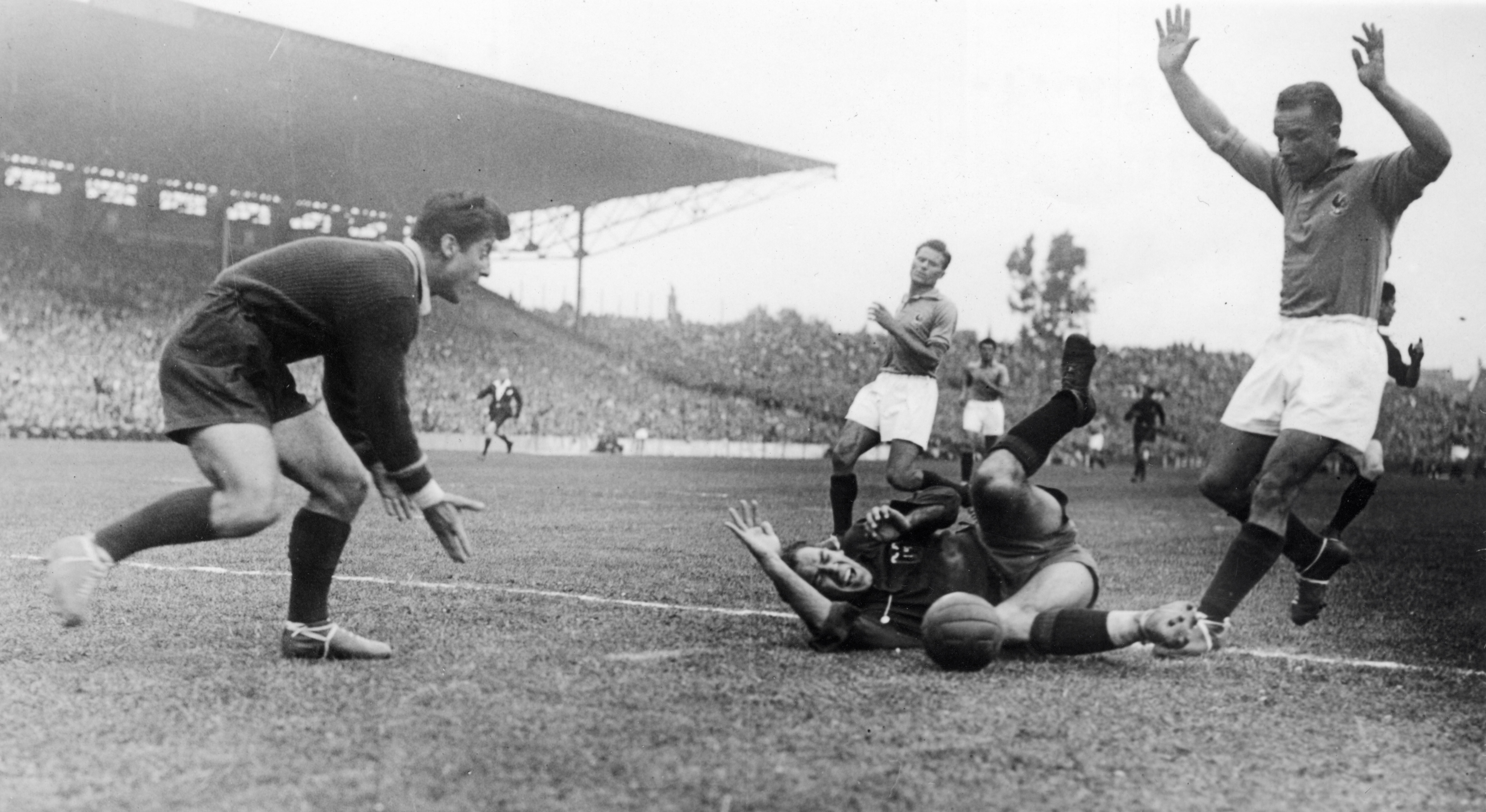
In mid-1949, the hard work had been taken on board and the definitive foundations laid a project that would end up shining in 1950 at the World Cup in Brazil. Behind this change was, firstly, the arrival of Benito Díaz as coach and, secondly, that good results began to follow and the new tactics began to be better understood. The stage of testing and assimilating concepts was over; now it was time to apply what had been learned.
After the defeat against the Italians, Benito Díaz was called into the national team setup to help Eizaguirre as a coach. With Díaz the team underwent great change. As coach of Real Sociedad, Benito Díaz was finally chosen as the man for the position of Eizaguirre's "assistant". Like Zamora, the so-called "Uncle Benito" was a believer in the WM tactic and, for many, the man who introduced the system in Spain. In truth, more than an initiator, he should be seen as the man who most strongly supported this model which had, in truth, had already been used by Real Sociedad in the 1930s and Valencia in the early 1940s. However, these teams’ use of the WM system had been little more than a minor flirtation that lasted no great length of time.
Benito Díaz surprised us with methods that were completely different from what we had seen to date. He took an active part in training as if he were another player.
Díaz, moreover, surprised the players with methods completely different from what they had been used to at the time. He took an active part in training as if he were another player. One of his strategies was to pick up the ball in his hands to stop the game at certain moments, demanding that everyone stay in their place in order to correct positioning problems.
‘Tío Benito’ marked the style for the national team and the players themselves. As far as the team's play was concerned, the new coach emphasised, above all, the need for interplay between the lines: "With the individual players Spain has, I don't think it would be too difficult to provide them with a great team that practises modern tactics to perfection".
If there was one match that marked a before and after moment in the history of the national team, it was the one played in June 1949 in Dublin. It was a turning point not only because of the 1-4 away victory over Ireland but also because of the way it panned out. With Spain coming back from a goal down with goals from Basora, Zarra (two) and Igoa, while playing spectacular football along the way. It had been a long time since we had seen such a brilliant Spain, especially during a first half that ended with a 1-3 lead. With fast and deep penetrating wingers, debutant Estanislao Basora filled the gap left by Epi on the right side and Gainza was decisive.
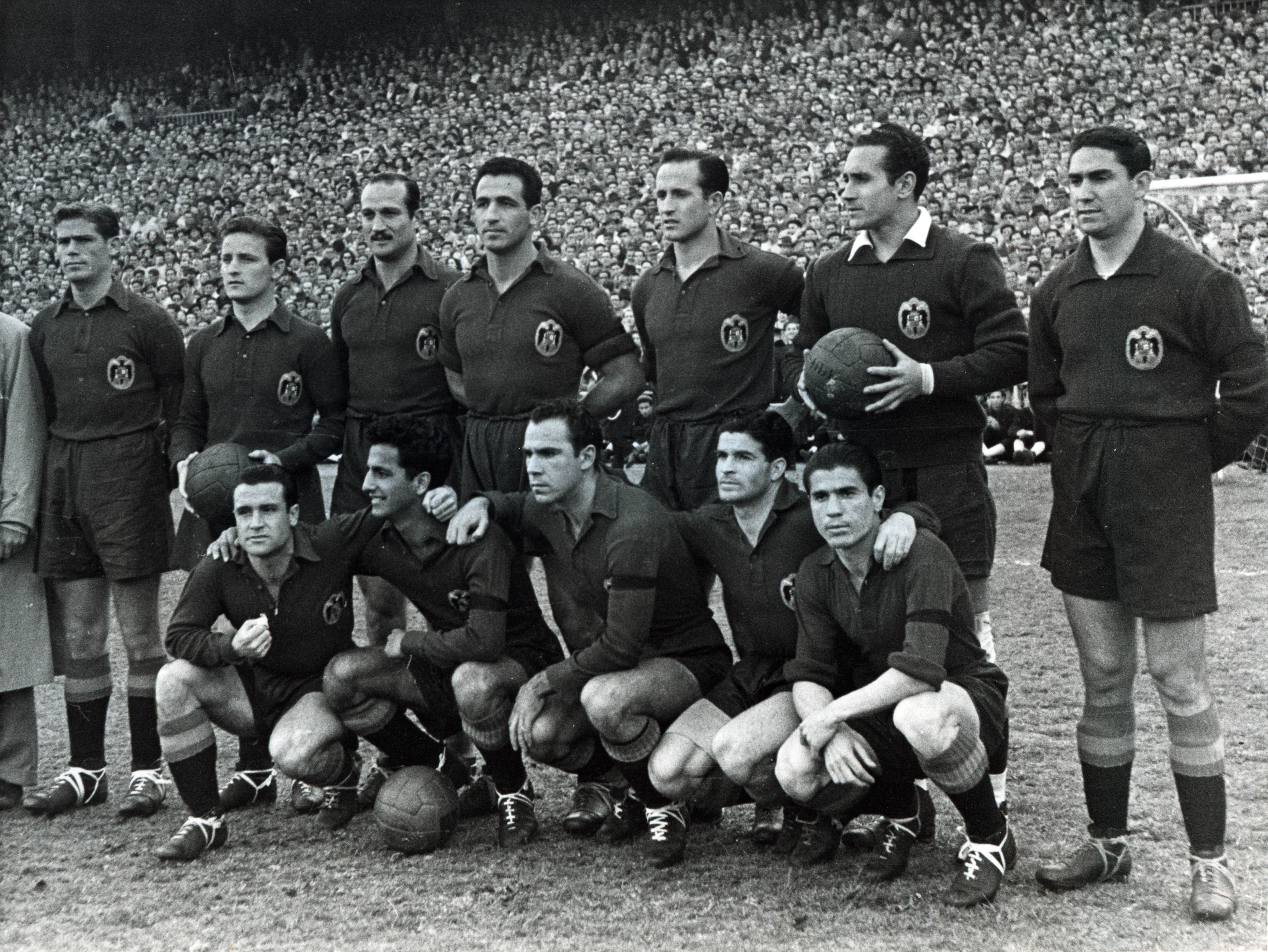
The line-up used in the match against Italy that marked a change of direction for the national team.
In addition, Zarra was in top form with his nose for a goal. The team was clearly beginning to take shape with Eizaguirre irreplaceable in goal; Gonzalvo III and Puchades in midfield. In the rest of the positions, there was still a lot of testing to be done, although Basora on the right and Panizo and Venancio as inside wide players were emerging as key components for the future. The victory against Ireland gave the team, in the words of Gonzalvo III, "a winning morale".
With that feeling of euphoria and change for the better, the team travelled to Paris where they trained in Saint Germain and Colombes with two secret weapons. The first, the food, as Diaz had brought olive oil with him from Spain so that the players would not notice the change in their diet. The other, in Diaz's words, was "disconcerting speed, an abundance of shots on goal from any position and the fury that we found in Dublin has not disappeared."
In Paris, Spain played with the same starting lineup as in Dublin, with the exception of Panizo. Spain were deserving victors, emphatically and brilliantly winning by five goals to one. Three goals from Basora and two from Gainza, who also provided two assists to the winger. Gainza, who scored a goal against Ireland, took over the right wing for the national team after his great performance on French soil. In just 12 minutes, Basora scored his hat-trick and was dubbed the "Monster of Colombes" by the French press. Basora did not hesitate to celebrate his success because, as he confessed years later, "in Paris one never sleeps and even less so after such a resounding international victory".
The forward line was almost entirely composed of Athletic Cub players; Venancio, Zarra, Panizo and Gainza with the sole exception of Basora as right winger. The backbone was Valencia's with Eizaguirre in goal, Asensi in defence and Puchades in midfield accompanied by the Barcelona player Gonzalvo III. Of the rest of the team that played in Colombes, the standout players were Sevilla's Antúnez in defence and Lozano, from Atlético de Madrid
Paris confirmed what had been seen in Dublin: This was a different Spain and one of the main reasons was clear.
Paris confirmed what had been seen in Dublin: This was a different Spain and one of the main reasons was clear. The results against Ireland and France seemed to confirm that the decision to bet on Eizaguirre and the change of model was a success.
The amazing sensations in Dublin and Paris had to pass through the filter of reality. And that was the next stage, the qualifying phase for the 1950 World Cup, which included a play-off against Portugal, Guillermo Eizaguirre continued his work advised by a Technical Committee made up of Eduardo Teus, Fernando Gutiérrez Alzaga, José L. Lasplazas, as well as Benito Díaz and Muñoz Calero.
As in 1934, Spain were not seeded and had to beat Portugal 1934 to get to Brazi
In April 1950, the moment of truth arrived: the match against Portugal that would decide who would go to the World Cup. In Chamartín, and with General Franco in the box, Spain easily defeated Portugal by a clear margin of 5 goals to 1. The match was decided in the first quarter of an hour when they were already leading 3-0. Against the Portuguese, the forward line was full of goals: a goal from Basora, another by debutant Molowny, two Zarra headers and another by Panizo completed the 5-1 final score. Gaínza did not score but provided three assists: two for Zarra and one for Molowny, who scored the goal of the match, for which he was congratulated by the referee, in English, of course.
Spain and Portugal drew 2-2 in the second leg in Portugal. Zarra made it 0-1 and, after the Portuguese took the lead after being behind, Gainza scored the equaliser to avoid another clash on neutral ground.
Eizaguirre's Spain were going to the World Cup and, above all, they would be going with a well-formed and cohesive team that had its own ideas and identity.
TO BE CONTINUED